

To enter love, feel it all.
my favorite love-themed films, books, and curiosities.
In Sophie Strand’s memoir, The Body is a Doorway, she quotes the poet Linda Hogan: to enter life, be food. I started this letter last week and have been tinkering with it daily, but something was always misaligned. What I was trying to communicate I didn’t yet have language for, and this quote kept lingering but I couldn’t puzzle out why.
I went to a screening of Hamnet yesterday and sobbed in the dark. Chloe Zhao spoke afterward with director Daniel Scheinert about her experience making the film and it invigorated me. She described the somatic impact of the actors internalizing so much grief, and so she required them, before and after particularly painful scenes, to pick a song and dance to it. Physically shake out the grief so they weren’t carrying it after filming. She used the words ritual and container often, which made my ears prick up in recognition. It sounded alarmingly similar to the therapeutic process: containing, integrating, releasing.
The Q&A itself opened with a dance. Zhao encouraged the audience to stand and shake out the grief we were holding after witnessing such a miraculously lush film of love and loss. And so the audience danced to “We Found Love in a Hopeless Place” as it blasted through tinny speakers. It felt particularly apt to bookend such a film with joy. Grief and joy are two sides of the same coin.
What wouldn’t come together when I started writing was this: the juxtaposition of grief and love. I knew they were inextricably linked, but I couldn’t yet verbalize why. Hamnet and Zhao helped me understand. Grief is love. To celebrate love we must also celebrate loss.
So my associations: mourning rituals and grief traditions, hand-fasting, mourning jewelry. The mythopoetic retellings of Orpheus and Eurydice, Cupid and Psyche. The cosmic irony of Romeo drinking poison, thinking Juliet dead, only for her to wake minutes later, too late. The gothic tradition held the two close—morbidity and mortality. Heathcliff, wild with grief, frantically digging up Cathy’s grave to hold her one last time. Faulkner’s Emily, the grey hair on the pillowcase beside the bones of her beloved. Mary Shelley preserving a piece of Percy Shelley’s heart, wrapped in poetry, in a box on her desk.
If death is the foil for life, grief is the foil for love. You cannot speak of one without the other. So when Linda Hogan says to enter life, be food—I think: to enter love, feel it all. Like life, love is a contract in which suffering is almost certainly guaranteed. I say this not with pessimism, but from the understanding that we are soft and finite. All things end. To accept love is to accept that your beloved will end, that you will end, but that is all part of the cosmic dance. To shield yourself from grief and pain is to shield yourself from love and joy. One cannot exist without the other.
Films About Love (& Loss)
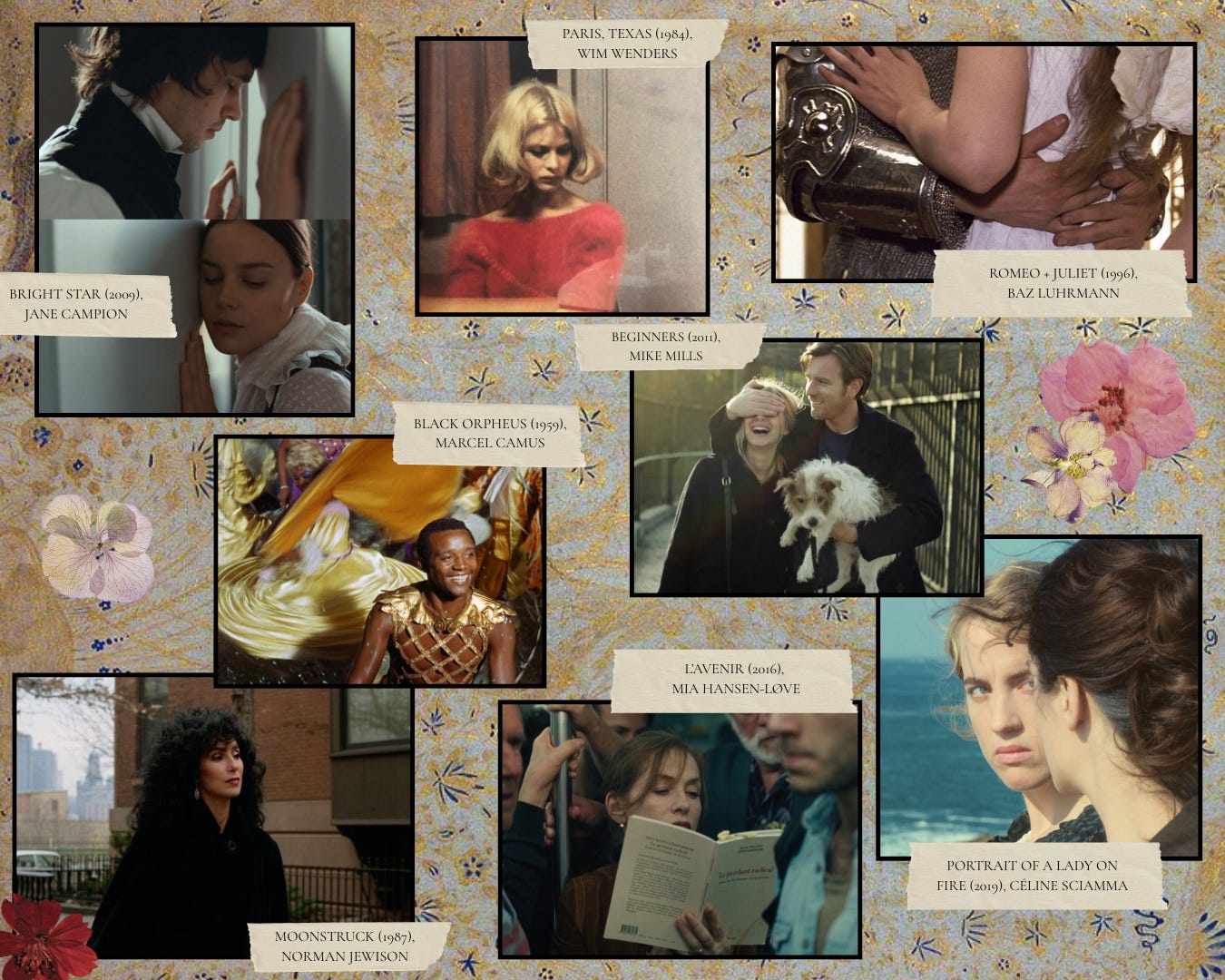
Bright Star (2009), Jane Campion. John Keats is my favorite of the Romantics aside from Mary Shelley, perhaps because his life was cut tragically short before he could do anything gross and chauvinistic like Lord Byron. I first fell for Keats in high school after reading Ode on a Grecian Urn, my favorite AP lit teacher pulling out all the theatrical stops in his recitations. Since then I’ve dreamed of visiting the Keats House Museum in Hampstead and seeing all the letters and gifts exchanged between him and his greatest love, Fanny Brawne. You can also see the engagement ring Keats gave to her, which she wore until her death in 1865.
Portrait of a Lady on Fire (2019), Céline Sciamma. Sciamma is an incredible director. Heloise, who has just left the convent and is to be married soon, is to have her portrait painted by Marianne—only, it must be done in secrecy without Heloise knowing. It’s been a minute since I’ve watched it, but so much of the symbolism and imagery is seared into my mind. Sciamma masterfully uses the female gaze as a device to explore what it meant to be a queer woman living under the patriarchy in 1770 France.
Beginners (2011), Mike Mills. A semi-autobiographical film by Mike Mills about his father coming out and embracing his sexuality near the end of his life. The film parallels two love stories: one of Oliver and Anna, and another of Hal and Andy. It handles the beauty and complexity of grief and love (and what happens when the two occur simultaneously) so tenderly. It will always be a favorite.
Black Orpheus (1959), Marcel Camus. A retelling of the classic Hellenic myth of Orpheus and Eurydice that takes place in Brazil during Carnival. Camus beautifully captured afro-latino culture and life in the favelas through the vessel of this tragic love story. It is vibrant, joyful, and tender, even if tragic. The score is also wonderful, featuring the music of Luiz Bonfá and Antonio Carlos Jobim.
Moonstruck (1987), Norman Jewison. Incredible for so many reasons, but here are my top two: number one, Cher. That’s it. Number two, this may be the only film where I am attracted to Nicholas Cage.
“We are here to ruin ourselves, and to break our hearts, and love the wrong people.”
Romeo + Juliet (1996), Baz Luhrmann. I always associate this version of Romeo and Juliet with my childhood. My mother blasting the soundtrack in her car as we zoomed around Southern California, visiting places frequented in the film like the Venice Beach boardwalk. It will always hold a special place in my heart. Another incredible soundtrack that does not disappoint.
L’Avenir (2016), Mia Hansen-Løve. Watching this film feels like writing a love letter to yourself in ways I can’t quite explain. It follows the story of a philosophy professor (Isabelle Huppert) forced into upheaval following an unexpected divorce from her husband. I included it here because it decentralizes romantic love in the most wonderful way. The film is about the love you give yourself following tragedy, the love you pour into your family, and the cycles that continue after rupture.
Paris, Texas (1987), Wim Wenders. Lost love, time, longing. Sun-drenched montages of VHS-taped memories. The colors: hot pink cashmere, hardened earth, a sun-faded blue sky. The cinematography is astounding, and Wim Wenders is just the best. It couldn’t be left out.
Books
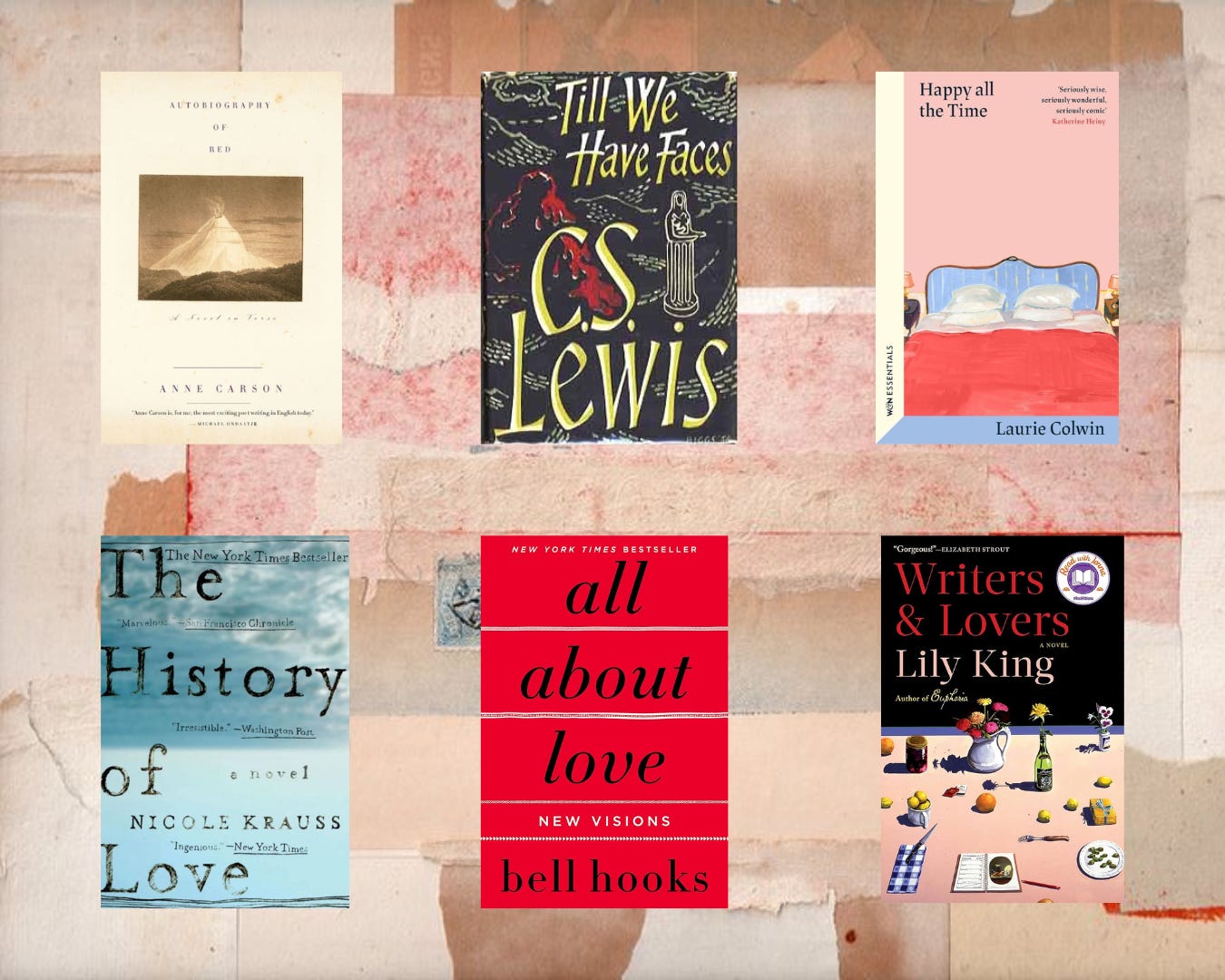
The Autobiography of Red by Anne Carson. This is the book that first introduced me to the genius of Anne Carson. She is one of my very favorite poets, and her translations are works of art. This book tells the story of Geryon, a red winged monster, who falls in madly in love with Herakles. Part myth part coming of age story, it is moving and tender and strange.
Till We Have Faces by C.S. Lewis. The story of Cupid and Psyche told from the perspective of Psyche’s older sister, Orual. We know the famous love story of Cupid and Psyche, but the lesser told story is the love between two sisters. It is a beautiful book, and is considered by many Lewis fans to be his most underrated novel.
Happy All the Time by Laurie Colwin. This book is delightful. When I finished it I had that same warm and fuzzy feeling you get after watching a Nancy Meyers film. It takes place in 1970s New York and focuses on two separate couples within a group of friends. It reads like Nora Ephron with a slightly more dry, satirical edge and observational eye.
All About Love by bell hooks. Including this is a requirement. hooks’ definition of love expands far beyond the romantic, taking it from passive longing to a state of active embodiment. Love becomes radical, a requirement for a more just, ethical, and free world. If you haven’t read it yet, now is a great time to start.
The History of Love by Nicole Krauss. I remember first reading this book at nineteen and being blown away by how stunning it was, how gorgeously Krauss’ writing flowed from one storyline into the next. It follows the stories of Alma Singer and Leo Gursky, the two arcs beginning separately and joining later in the book. Alma is determined to find a cure for her mother’s loneliness, the answer to which she believes will be found in locating the author of a mysterious book her mother is translating.
Writers & Lovers by Lily King. My feelings about this book are nearly identical to those of Ann Patchett’s: “Writers & Lovers made me happy. Even as the narrator grieves the loss of her mother and struggles to make art and keep a roof over her head, the novel is suffused with hopefulness and kindness.” I couldn’t have said it better myself.
Crafts, Curios, & Courtship
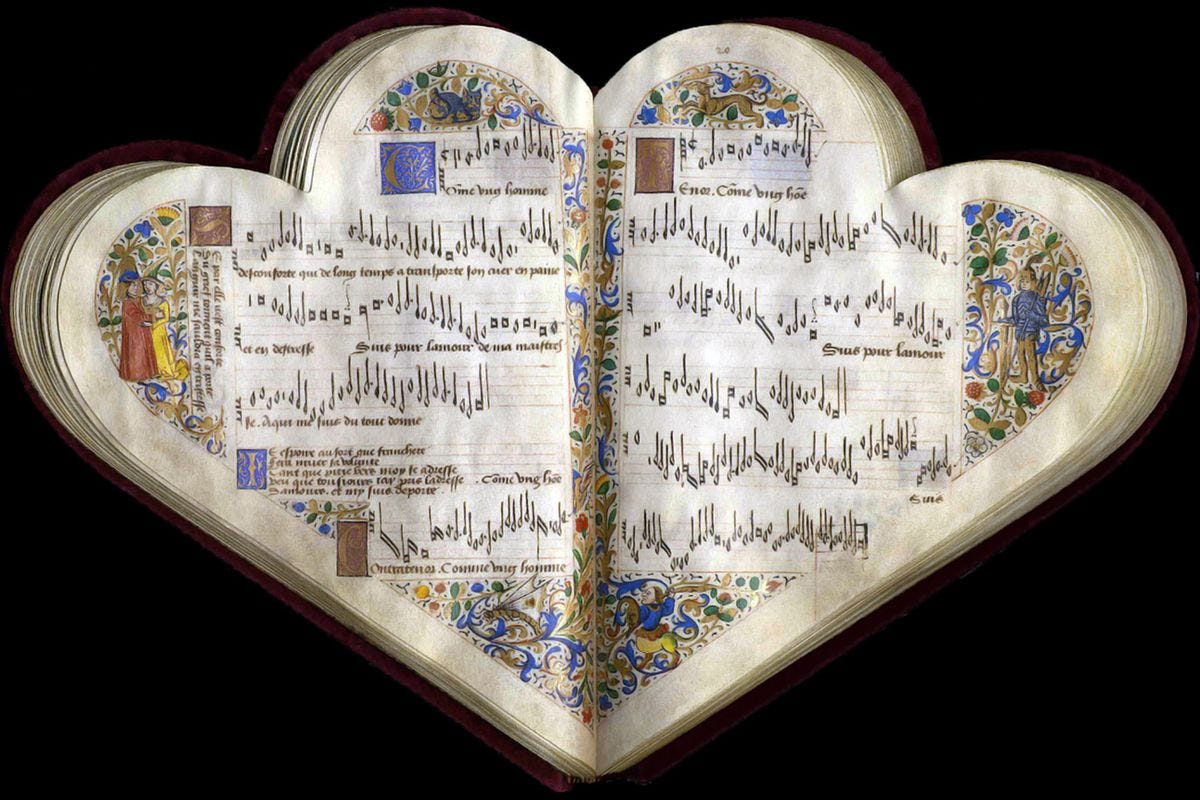
The Chansonnier de Cordiforme (France, circa 1475), a beautiful heart-shaped hymn book laden with gold leaf and a velvet cover from medieval Europe. Between its pages are 44 love songs and chants of courtship and romance. It is divine. Apparently you can buy it a facsimile of it here.
Victorian Love Tokens


I love puzzle letters. My best friend made me one for Valentine’s Day last year and I have it taped in my journal because I’m a sentimental fool and I save everything. But my most favorite recent discovery is the Cobweb Valentine, a delightfully macabre declaration of love and devotion.
Lover’s Eye


I wrote about lover’s eye jewelry in last year’s Valentine’s Day themed letter and I’m writing about them again. I am bewitched by these. They feel like sacred objects, relics imbued with the sweet memory of your beloved.
Afternoon Tea in a Rose Garden
If you’re in the Los Angeles area (specifically Pasadena), the newly-renovated Rose Garden Team Room at the Huntington Gardens looks absolutely gorgeous. I keep meaning to visit and still haven’t found the time, but it would be the perfect place for a sweet date or Galentine’s day celebration followed by a leisurely stroll through the gardens, which are likely in full bloom right now.
I leave you with one of my favorite love songs: “Where or When” by Peggy Lee & Benny Goodman. You just can’t beat Benny Goodman.
Thank you for sharing this beautiful piece Kaitlynn, reading it felt very soothing. It also made me want to go visit Keats House soon. x